How I Built a Full AI Operating System for Sales

We are in the age of AI, but a lot of sales organizations still run on people's memories of what happened. And people's memories are usually terrible.
I ran into this problem as a VP of Sales. I was overseeing a lot of deals while building the sales organization and onboarding new people at the same time.
We wanted to stay on top of every detail, give customers a great experience, and make sure we did not miss anything.
Because sales is cutthroat.
If you miss a follow up, your competition might not. If your proof of concept is disorganized, a competitor looks easier to work with. If you are slow on paper process, someone else gets another chance to take you out.
We had plenty of tools, but were still carrying too much in our heads. Which deals needed a bump, which proof of concept was missing something, which customer had gone quiet, and where I needed to step in.
Our systems stored information. They did not help advance the process.
So I started building my own way to do this.
It began as a CRM and kept growing. I now have a set of apps that help run deals, work with customers, prioritize what the organization needs, recruit people, and retain them. AI runs behind the scenes across everything
I did not simply add AI to a sales stack. I rebuilt the stack to plug into the way I wanted the organization to work.
The CRM I wanted did not exist
Most CRMs are good at storing a deal amount, an outdated next step, a stage, and a close date.
That is maybe 50% of what I need to know.
I need to know the who has the ball, whether we followed up, what is blocking the deal, how the paper process is going, what is happening in the proof of concept, whether the customer is using the product, and when someone on the team needs step in.
I also need to know when I should step in.
So I built my own CRM around those questions.
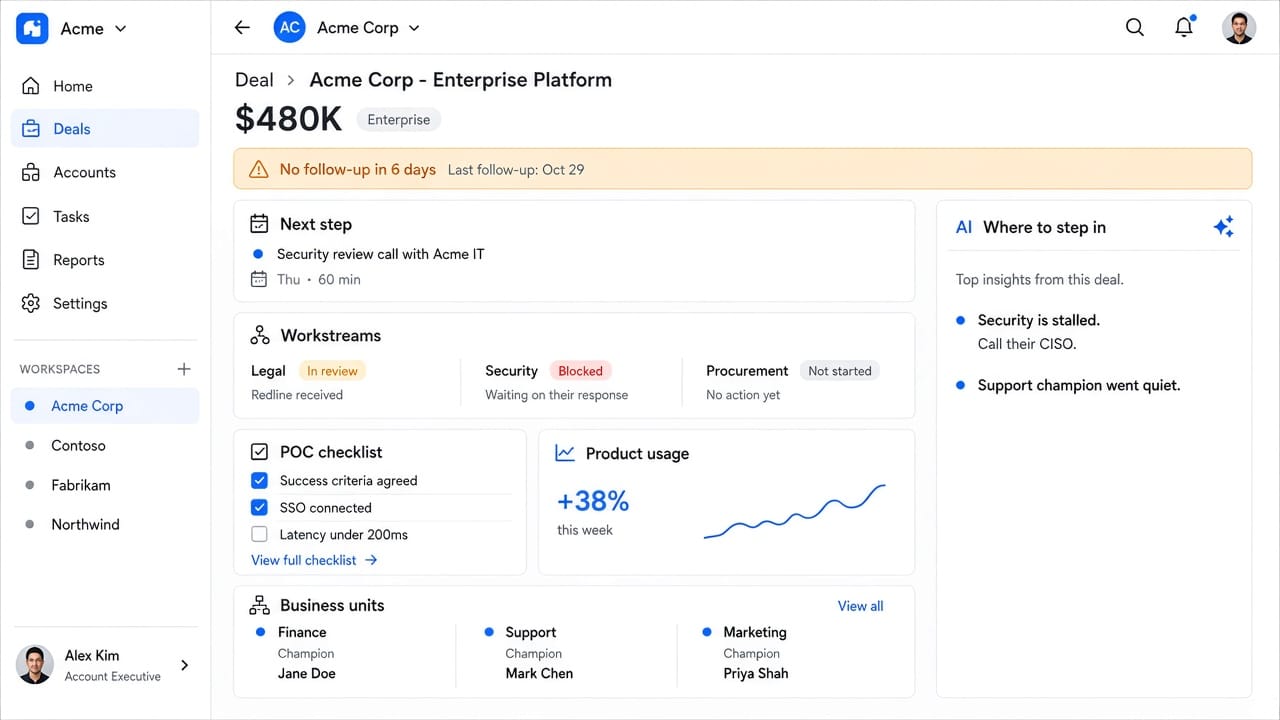
It tracks next steps and bumps us when we have not followed up. It tracks legal, security, procurement, and the other workstreams that can hold up an enterprise deal. It walks through our proof of concept process and shows what is done, what is missing, and what needs to happen next. It also pulls in product usage so we can see what is happening between meetings.
Large deals get complicated. You might be selling into several business units at the same company, and each one has a different buyer, champion, use case, process, and timeline. A normal CRM makes that look like one account with random activity attached to it.
My system tracks the threads separately while still showing us the full account.
It also checks our work.
Did the customer agree to the next step? Do we know what success looks like for the proof of concept? Are we moving the deal forward, or did someone just change the stage? Did legal and security start early enough? Is the customer using the product the way we expected?
The system reminds the team about things without me having to chase everyone, and it tells me when something needs my attention. I do not want to ask people for updates all day. I want to know where something is stuck and where I can help.
It also finds better reasons to contact a customer. If we release a feature, publish a blog post, make a video, or create something useful for an account, it reminds the seller to send it.
I rebuilt the sales deck as an app
The next thing I built started as a sales deck.
A normal deck is out of date almost as soon as you present it. Then the deal gets spread across email, documents, spreadsheets, call notes, mutual action plans, and whatever else the customer wants to use.
Nobody has the full picture in one place.
So I turned the deck into an interactive app that also works as a deal room.
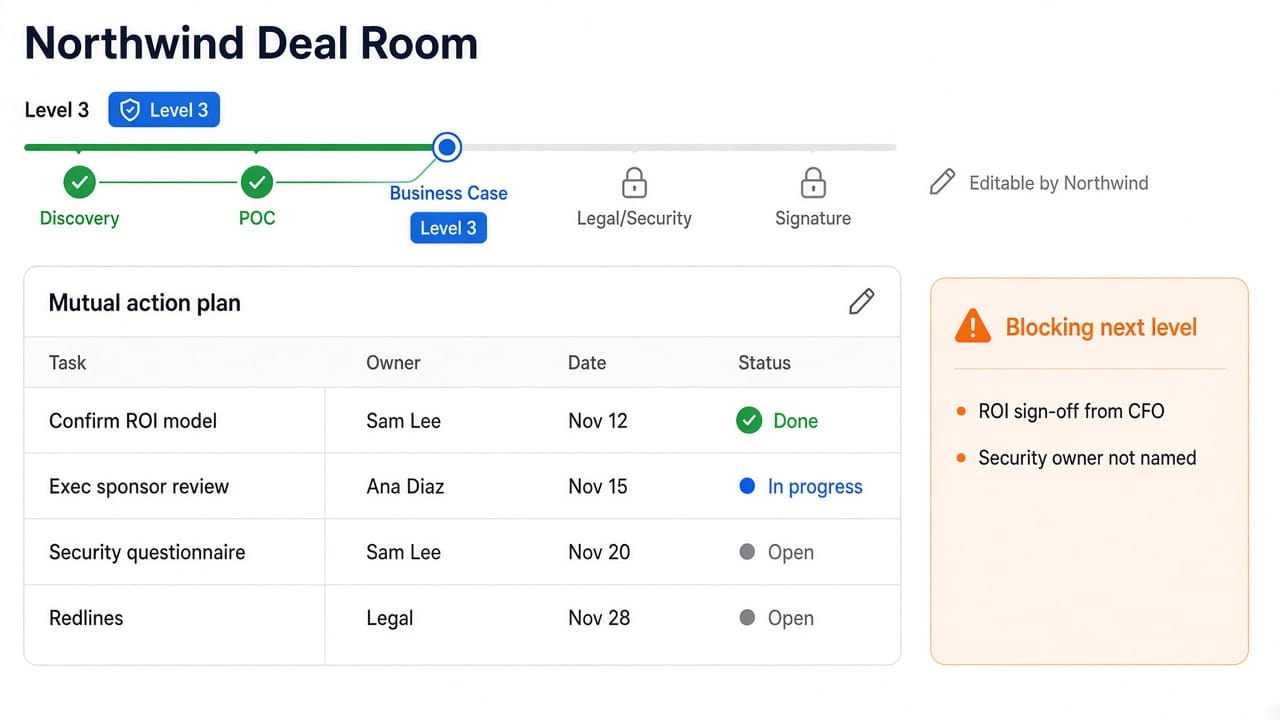
It walks the customer and our team through the project from beginning to end. It shows where we are, what we finished, what is missing, who owns what, and what has to happen before we can move forward.
It covers the proof of concept, the business case, the mutual action plan, legal, security, and both sides' internal processes. The customer can fill in details and change parts of the process based on how they want to work.
I think about it like a video game.
A good game makes the objective clear. You know where you are, what you need to do next, and what you have to complete before you can get to the next level.
Enterprise deals can work the same way.
Both sides can see what is holding things up. We are not just presenting a plan to the customer. We are working through the plan together.
Then I built an app for building the sales organization
Running deals is one part of the job. Building everything the sales team needs is another, and that work never ends.
There is always new messaging, onboarding, enablement, pricing, customer research, content, reporting, hiring, or process work to do. The hard part is deciding what matters now.
I built another app that puts the work into an Eisenhower Matrix. It shows what is urgent, what is important but can wait, what I should delegate, what belongs in a future quarter, and what we should not do at all.
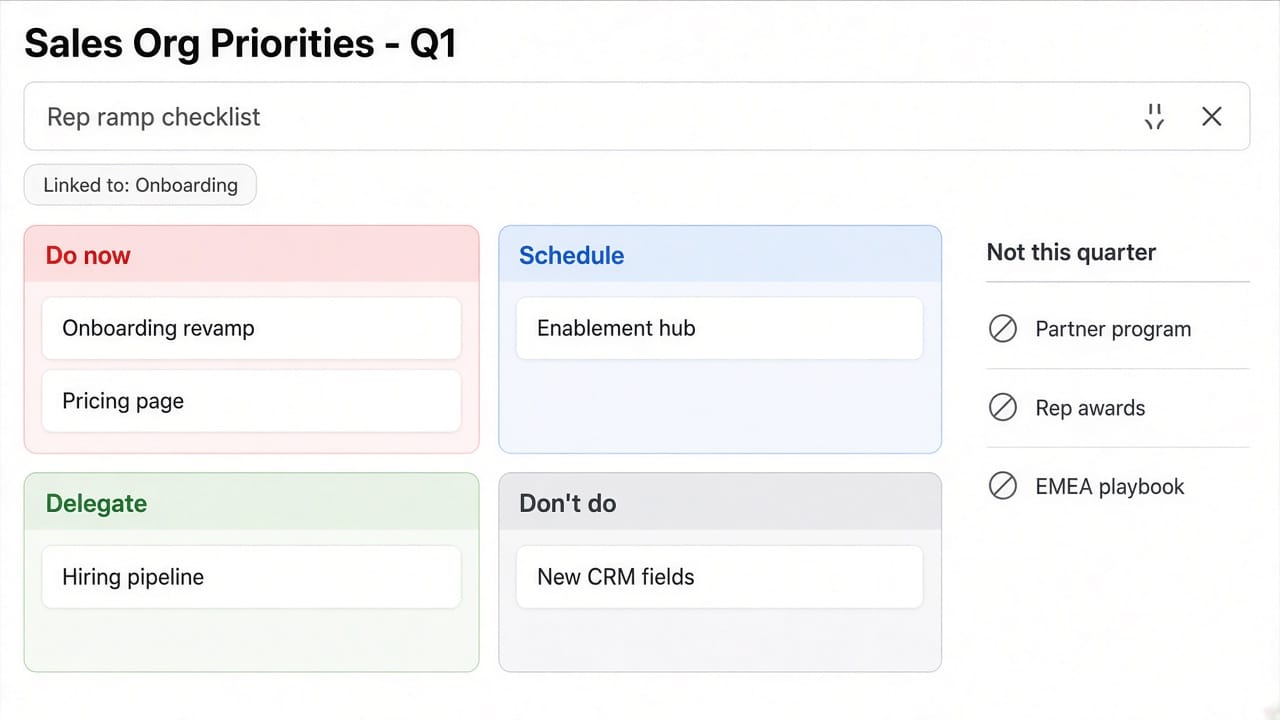
If I add an idea, the system checks whether it belongs to something already underway. If it does, it connects the idea to that project. If it does not, it puts it in the right place for later.
The plan changes when the business changes. If a customer need becomes urgent, the pipeline shifts, we make a new hire, or the company changes priorities, the app helps reprioritize the work.
This became the roadmap for building the sales team. It also helps me say no. AI can create an unlimited amount of new work if you let it. A useful system has to help decide what matters and what to stop doing.
Revenue, recruiting, and retention
I have noticed that almost everything I build eventually turns into three versions: revenue, recruiting, and retention.
Recruiting is a good example.
I built an app that manages the recruiting pipeline by role. It reviews resumes and profiles based on what I care about, shows people we know in common, tracks each stage, and keeps the interview questions and scorecards in one place.
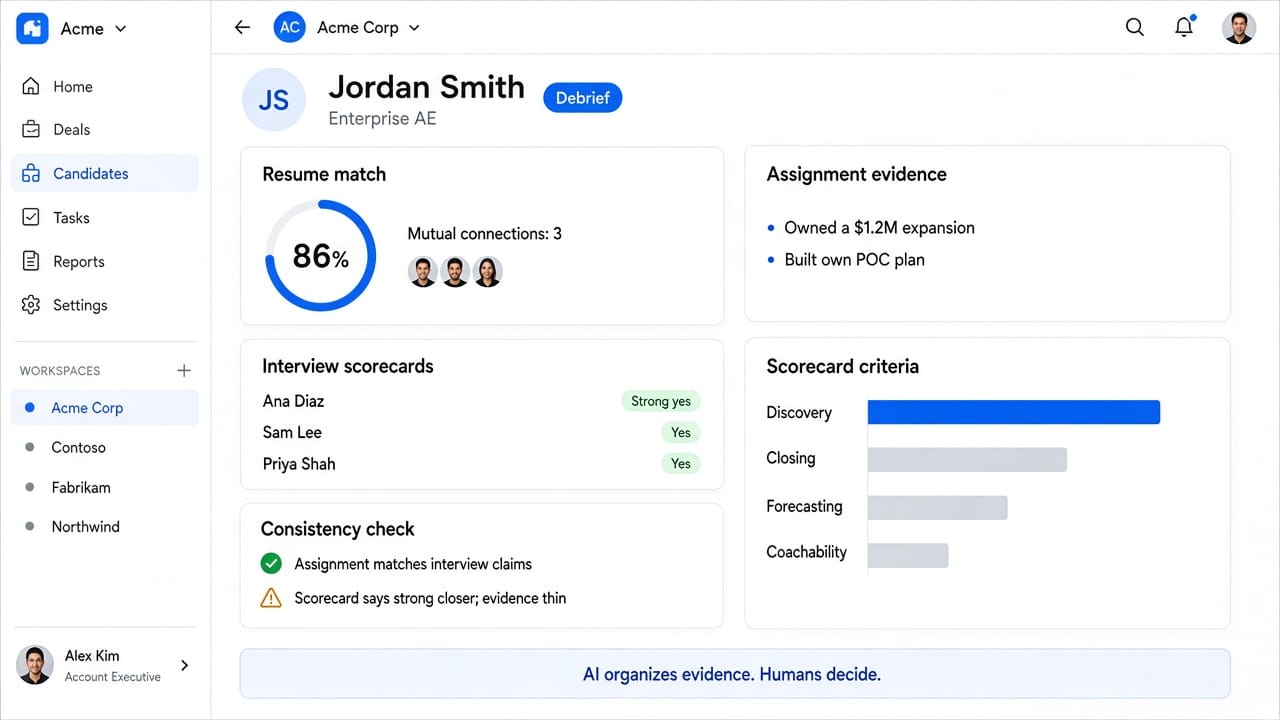
When someone completes an assignment, the app reviews it against what the job requires and pulls the evidence into the candidate's profile.
Hiring gets messy because the information is spread everywhere. One interviewer loved the person. Someone else had concerns. The resume looks great. The assignment is just okay. Then everyone gets into a debrief and the decision can depend on whoever has the strongest opinion.
I want the system to show us the full picture.
What did this person own? What did they personally do? What was difficult? What decisions did they make? What changed because of their work? Does the assignment match what they told us in the interview? Does the evidence support the scorecard?
The app does not make the hiring decision. It organizes the evidence so we can make a better one.
The same idea applies to retention. The system should remember what happened, notice when something changes, flag risk, and put the right issue in front of the right person before it becomes a bigger problem.
How I build these systems
I do not start by asking where I can use AI.
I start with something that is frustrating, keeps happening, and depends on someone remembering what to do.
Then I use the same process.
1. Find the thing that keeps breaking
Maybe follow ups get missed. Maybe proof of concepts start without clear success criteria. Maybe customer threads are spread everywhere. Maybe interview feedback is inconsistent. Maybe important projects keep losing to whatever feels urgent that day.
If the same problem keeps coming back, I look for the part that should be built into the system.
2. Write out the whole process
Where does it start? What information do we need? Who owns each part? What has to happen before we move forward? Where does it usually get stuck? Which parts should happen automatically, and which need a person?
If I cannot explain how the process should work, an app will not fix it for me.
3. Build the prompt before the app
This is critical. Most people jump into the interface, integrations, and automations before they have clearly explained what they want the AI to do.
I write one detailed prompt with the goal, context, information it should use, steps to follow, rules, examples, what good looks like, what it should never do, and what the output should include.
I also tell it what to do when information is missing. Should it ask a question, flag the gap, stop the process, or make a recommendation based on what it knows?
Then I test it against real deals, candidates, projects, and edge cases. Every bad answer tells me something is missing. I add context, a better rule, a stronger example, or another check until it can run the process the way I want.
Only then do I build the rest.
If the prompt is bad, turning it into an app just gives you a faster way to get a bad answer.
4. Pull the information together
The information is usually already there. It is just spread across the CRM, product usage, call notes, email, documents, spreadsheets, and different people on the team.
A seller should not have to open six tools to understand one account. I should not have to search five documents to understand a candidate or figure out why a project is late.
5. Build the standard into the system
I do not want a checklist that says we need a mutual action plan. I want the app to check whether the plan has the right people, owners, dates, customer commitments, and steps required to get to a decision.
The same applies to discovery, proof of concepts, interviews, hiring assignments, and everything else. The system needs to know what good looks like.
Some things should not move forward just because someone changed a field. A proof of concept should not start without success criteria. A deal should not move stages without a real next step. A candidate should not move forward because an interview felt good.
6. Give each agent one clear job
I do not have one agent trying to do everything.
One monitors follow ups. Another checks how we are running a deal. Another watches product usage. Another matches new content to customers who might care about it. Another organizes interview feedback. Another helps reprioritize what we need to build.
The apps pull the work together and tell me what changed, what is stuck, what is at risk, and where I should step in.
What my job looks like now
I still talk to customers, coach sellers, recruit people, work with the rest of the company, and make decisions.
AI did not replace any of that.
It changed how I manage all the moving pieces around it.
I spend more time deciding what the system should remember, what should happen automatically, what needs a review, what should cause an alert, and which repeated mistake needs to become a rule.
I am managing people and agents at the same time.
The people bring judgment, creativity, relationships, and trust. The agents remember things, connect information, check the work, and keep the process moving.
Where this is headed
Most people started using AI to write an email, summarize a call, research an account, or update a forecast.
Those things are useful, but they are still individual tasks.
I am more interested in using AI to run the full process.
Sales leaders can now build the CRM around the way they sell, the deal room around the way their customers buy, the recruiting system around how they hire, and the management system around where they need to step in.
You do not have to turn every part of the company into an app.
But look at how much of your organization still depends on someone remembering the right thing at the right time.
That is the stuff I am moving into the system.
The more I build, the less the organization depends on memory and the more it learns from everything we have already done.
In a cutthroat market, staying on top of the details is an advantage. I want AI to help us make sure we do not miss a thing.